Sunday, November 13, 2011

How to Make Dumplings

Dumplings are one of the traditional foods in China, people, especially those who live in North China, not only have dumplings in festivals, but also take them as a staple in daily life. 
 
Today, let's learn how to make dumplings.
 

Generally speaking, people prefer to make dumpling wrappers by themselves with flour and water, however, to a beginner, buying dumpling wrappers in super market is a good choice because making dumpling wrappers manually is a complex process to a beginner.
 

Now, let's make sure what kinds of materials we shall prepare.
1、Dumpling wrappers
2、Stuffing, including meat and vegetable
3、Soy sauce, salt, cooking wine, spice powder, sesame oil, cool water

Now, let's start!
 

First, choose your favorite meat and vegetable, each one should be a half pound, and chop up both of them.


Vegetable


Meat

Second, put them in a big container, add one tsp of salt, ten tsp of soy sauce, one tsp of spice powder, three tsp of sesame oil, and five tsp of cool water.


Put all the stuff together

Third, stir the stuff in one direction for five minutes.


 Stuffing

Fourth, hold a dumpling wrapper, put one tsp of stuffing in the middle of the dumpling wrapper, double up it and wrap up the stuffing.


The process of wrapping up the stuffing

Fifth, finish making dumplings with the same process explained above.
 

Sixth, boil a pan of water.
 

Seventh, put the dumplings into the boiling water carefully.
 

Eighth, add cool water three times after the pan of dumplings is boiling again.
 

Ninth, turn off the fire, dish up the dumplings.
 

Tenth, make your favorite sauce for the dumplings, such as soy sauce, vinegar, and chili sauce.


How yummy! What are we waiting for? Le's get started!


Saturday, November 12, 2011

Peking Opera

Peking Opera grew up in Beijing around 1840, was popular in 1930s and 1940s, and it is the national opera in China.

Because women could not get publicity in old times in China, female roles, which is called "Dan" in Peking Opera, were acted by males. Mei Lanfang, name of a very famous Peking Opera artist, is acknowledged to be a master of Peking Opera and was one of the four famous Dans in Peking Opera at the time of 1940s.


Mei Lanfang


A still of Mei Lanfang

Facial makeup plays an important role in Peking Opera, and it is one of the essential labels of Peking Opera. Facial makeup is only for male roles. Different types of facial makeup stand for different roles, characters and fates, and they can help audience understand the story of a opera.

Colors of Faces             Nature               Characters                 Roles 
Red                               Positive              Loyal, Brave 
Black                            Neutral                Bold
Blue & Green                 Neutral                                                Gallant Outlaw
Yellow & White              Negative             Evil
Golden & Silver              Mysterious                                          God, Demon


Different kinds of Facial Makeup
 
With the quickening pace of modern life , more and more young people are no longer very hot on Peking Opera. However, a young artist named Li Yugang, who acts as a Dan in Peking Opera, has opened a new chapter for the Peking Opera. He combines fashionable elements to Peking Opera and creates a unique style of singing. 


The Drunken Beauty  is one of the most famous episodes in Peking Opera. The following video shows a traditional style of acting. Audience who are not familiar with or lack of basic knowledge about Peking Opera will find these kinds of operas super boring.


However, Li Yugang creates a new acting style. The vedio below, which is named The New of The Drunken Beauty, is the creation of Li Yugang.


Not only does Li Yugang bring fashionable elements to Peking Opera, but he also performs popular songs with a Peking Opera style. The video called One Night in Beijing is a great example.


The Original of  One Night in Beijing


Li Yugang's One Night in Beijing

Because of Li Yugang, a great many of young people begin to pay close attention to and love Peking Opera. What Li Yugang done has made great contributions to the development of Peking Opera.

Friday, November 4, 2011

Famous Foods in Chengdu

Chengdu is the capital of Sichuan Province in southwestern China. The city is famous of its laid-back way of living due to its local landscapes and snacks. The local flavor snacks in Chengdu are super popular in China because of the gamey characters and great varieties, such as, wonton, chow mein, brawn, confiture, pastry, etc., more than 200 kinds of foods consist of the unique local snacks. 
 
The video records
Andrew's trip of visiting different famous snack bars in Chengdu. 

 
The eight snacks listed below are super famous in Chengdu, as well as in China, which are also appeared in the video.

Chen Mapo Tofu
Chen Mapo Tofu is a famous shop named by the country. It opened in 1862. Because the color of the tofu is ruddy and the beef shreds is crispy, it had be a namable food since the end of the Qing Dynasty. 

Chen Mapo Tofu

Shuangliu Rabbit Head
The shop opened in 2003 and has a eight-year history. This snack sounds terrible, however, the characters of the food are hot and spicy, and it is very popular.

Sliced Lungs
It is said that a couple made this snack with ox's lungs in 1930s and many people loved it. After the shop was founded, the materials was changed with beef, tripe and oxtongue.  

Sliced Lungs

Spiced Griskin
It has a 100-year length of history. Because of its high requirements during the process, spiced griskin stands in top in the field of pot-stewed dishes.

Dan-dan Noodle
Dan-dan Noodle is a famous foodstuff in Chengdu. Here is the process of making it. Roll flour into noodle, boil the noodle, and combine it with saute minced pork. It seems very simple, but more simple means more difficult.


Dan-dan Noodle

Wonton
The wonton in Chengdu is another very famous food. Its main characteristics are the thin skin, crispy minced meat and delicious soup.

Wonton

Zhong Dumplings
Contrasted with the dumplings in north China, Zhong dumplings are made with chopped pork and without any vegetables. Its taste is hot and spicy, as well as a little sweet. 

Jelly
It is produced in the end of Qing Dynasty. It tastes cooling and delicious.


Jelly 

There are hundreds kinds of foods in Chengdu, and they are so famous and popular that a great many tourists go to Chengdu just for their favorite foods every year. It is amazing and unbelievable, but it is ture.


Wednesday, November 2, 2011

Winter Solstice

Winter Solstice was the earliest solar term that was worked out in ancient China, and its date changes among 21,22 and 23 December due to the Sun and the Earth. Winter Solstice is the day that has the shortest daytime and the longest dark hours among a year. 

In China, people in the north prefer to have dumplings while other areas have different foods for the solar term. Now, let's have a look at different customs in different regions in China.

Natives in Suzhou——have wonton due to the memory of Xishi
Suzhou was the capital of Wu 2,500 years ago. The beauty, Xishi, played an important role in the battle between Wu and Yue. The food, wonton, was made by Xishi for the King of Wu in winter solstice, and it was named by Xishi. The meaning of the name was an metaphor, which referred to the stupid King. Because Yue won the war under the help of Xishi, people in this region began to have wonton in winter solstice in order to the memory of Xishi.

Wonton

Natives in Ningxia——have "tounao"
The custom for Winter Solstice in Ningxia is to have a kind of soup, which is made of mutton and rice noodle. People call it by a strange name: tounao, which means the head.

Nativies in Chaoshan——ancestor worship, have sweet bolls and visit graves
On the of winter solstice, people in Chaoshan prepare enough pork, chickens, fishes and fruits and go to ancestral halls for ancestor worship. Generally speaking, the ceremony finishes before lunch, and family members get together for lunch, sweet balls is one of the delicious food.

Visiting graves is another activity in Chaoshan in winter solstice. In general, people usually visit graves in Qingming Festival, however, because of the better weather in winter solstice, people in Chaoshan prefer the latter day. 

Natives in Yunnan, Guizhou and Sichuan Province——have mutton and mutton soup
On the day of winter solstice, people in this region always like to enjoy something delicious. They have mutton and mutton soup in order to keep warm and to hope "good luck" during coming year.


Mutton soup

Winter Solstice is important in China, even though the Chinese people who live abroad still celebrate the festival every year and keep these customs.

Tuesday, November 1, 2011

Chinese Calligraphy

Chinese calligraphy is an old art of writing Chinese characters with writing brushes. There exist nine different kinds of Chinese calligraphy on the way of its development, there are: oracle bone script, stone script, Chinese Bronze inscriptions,large seal script, small seal script, clerical script, cursive script, regular script,and semi-cursive script. 

Chinese calligraphy is an unique kind of visual art and Chinese characters play important roles in it, because contrast to other kinds of calligraphies, Chinese characters is the essential symbol of Chinese calligraphy.

The process of learning Chinese calligraphy can be divided into four steps.

The first step is tracing. That is, use a semitransparent paper to cover over the originals and trace them.
 
The second step is copying. That is, practice writing original forms of characters from a copybook of calligraphy on other papers.

The third step is writing from memory. That is, close the copybook of calligraphy and practice writing original forms of characters from memory.

The last but not least step is creation. That is, create your own calligraphy works based on the former three steps.

The four steps above seem simple, however, it is a very long process, as well as difficult. I once had learned Chinese calligraphy for almost eight years since I was five years old, and I am good at small seal script, clerical script, regular script,and semi-cursive script.The following works that I once learned are completely famous in the history of Chinese calligraphy.

Stele of Cao Quan is typical of clerical script.


This work is called Preface to the Orchid Pavilion Collection. It looks really elegant and it is the number one in the field of semi-cursive script. Unfortunately, it is a copy, the original work had been an emperor's funeral object in Tang Dynasty.

Monday, October 31, 2011

Three major Ethnic Minorities

As a large united multi-national state, China is composed of 56 ethnic groups. Among them Han Chinese account for 91.59% of the overall Chinese population and the other 55 make up the remaining 8.41% . As the combined population of these other ethnic groups is far fewer than that of the Han, they form the 55 ethnic minorities of China. These numerous ethnic groups share China's vast lands but at the same time many live in their individual communities. The relationships between the different ethnic groups have been formed over many years. The 55 ethnic minorities have their own festivals, traditional clothing, life styles, cultures, customs, languages, or even written languages, and their life is always full of color and pleasure.
 
Major Chinese ethnic minorities map
Because of the huge number, it is impossible to involve all the 56 ethnic groups in this post, so I will just talk about three major ethnic minorities.

Bai Ethnic Minority
The Bai costume has a long history. As long as 1,800 years ago, the Bai wove a kind of cloth known as "Tonghua.” During the Nanzhao Regime and the Dali Kingdom, the Bai created their own styles of clothing. Now, the clothes of the Bai people are bright and well-matching in colors, delicate and fine in embroideries, and plain and simple in style.

Bai clothing is usually adorned with camellia flowers because they view these flowers as a symbol of beauty. The Bai enjoy their lives and love flowers. They like to wear a red scarf on their shoulders and a white outer upper garment, a combination that resembles blooming camellias.
The Bai clothing for females
The Bai clothing for males

Mongolian Ethnic Minority

Many Mongols live in modern urban housing for a part of the year, but switch to the ger. At other times of the year in order to tend to domestic animals (sheep, goats, etc.). The Mongolian ger is practical in every way: it is quickly collapsible and packs away to almost nothing, making it easy to transport; its ground-hugging base and its conical top - which also sheds rain instantly - help keep the ger snug to the ground, even in strong winds; and inside, it is very roomy and ventilated. The Mongolian ger consists of a wooden, lattice frame, sometimes in sections.
Gers

Inside of a ger
 
Tibetan Ethnic Minority
Tibetan people believe in Lamaism. The believers must recite or chant Buddhism scriptures very often. For illiterate people, what they can do is to turn prayer wheels, with scriptures inside. Turning the prayer wheel is equivalent to chanting some scriptures and it has become routine work for Tibetan people. A lot of Tibetans keep portable prayer wheels at home. Prayer wheels are of different sizes and quality. But there is one thing in common, that is they all have scriptures inside. Followers of Yellow sect turn the wheel clockwise, while followers of Black sect turn it anticlockwise.
Lamas in a lama temple

The Mid-Autumn Festival

The Mid-Autumn Festival is one of the most important festivities in China, According to Chinese lunar calendar, the 15th day of the 8th month is the exact midst of autumn, so it's called the Mid-Autumn Festival.This day is also considered as a harvest festival since fruits, vegetables and grain have been harvested by this time and food is abundant. The Mid-Autumn Festival is an evening celebration when families gather together to light lanterns, eat moon cakes and appreciate the round moon. On that night, the moon appears to be at its roundest and brightest. The full moon is a symbol for family reunion, which is why that day is also known as the Festival of Reunion.
The Moon on the Mid-autumn Day

History
The Mid-Autumn Festival is a traditional festivity for both the Han and minority nationalities. The custom of worshiping the moon can be traced back as far as the ancient Xia and Shang Dynasties (2000 B.C.-1066 B.C.). In the Zhou Dynasty (1066 B.C.-221 B.C.), people hold ceremonies to greet winter and worship the moon whenever the Mid-Autumn Festival sets in. It became prevalent in the Tang Dynasty (618-907) that people enjoyed and worshiped the full moon. In the Southern Song Dynasty (1127-1279), however, people sent round moon cakes to their relatives as gifts in expression of their best wishes of family reunion. When it turned dark, they gazed up at the full silver moon or went sightseeing by lakes, to celebrate the festival. Since the Ming (1368-1644) and Qing dynasties (1644-1911), the custom of Mid-Autumn Festival celebration has become unprecedentedly popular.

Different Celebrated Forms
Today, festivities centered about the Mid-Autumn Festival are more varied. After a family reunion dinner, many people like to go out to attend special performances in parks or on public squares. People in different parts of China have different ways to celebrate the Mid-Autumn Festival. 

In Guangzhou in South China, a huge lantern show is a big attraction for local citizens. Thousands of differently shaped lanterns are lit, forming a fantastic contrast with the bright moonlight.

In Zhejiang, a province in East China, watching the flood tide of the Qian-tang River during the Mid-Autumn Festival is not only a must for local people, but also an attraction for those from other parts of the country. The ebb and flow of tides coincide with the waxing and waning of the moon as it exerts a strong gravitational pull. In mid autumn, the sun, earth and moon send out strong gravitational forces upon the seas. The south of the Qian-tang River is shaped like a bugle. So the flood tide which forms at the narrow mouth is particularly impressive. Spectators crowd on the river bank,watching the roaring tital waves.

Moon Cakes
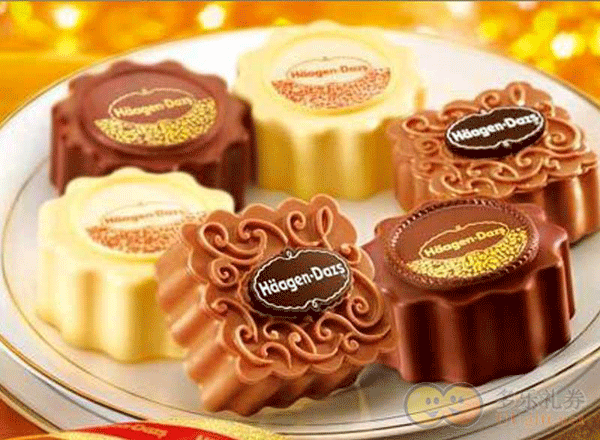
Moon cakes are the special and unique food for the Mid-Autumn Day. For generations, moon cakes have been made with sweet fillings of nuts, mashed red beans, lotus-seed paste or Chinese dates, wrapped in a pastry. Sometimes a cooked egg yolk can be found in the middle of the rich tasting dessert. Today, there are hundreds varieties of moon cakes on sale a month before the arrival of Moon Festival. In America, people can buy moon cakes in Chinese supermarkets or China Town around the date of the festival.

 
Traditional moon cakes


Different kinds of moon cakes in modern times